
The Situation
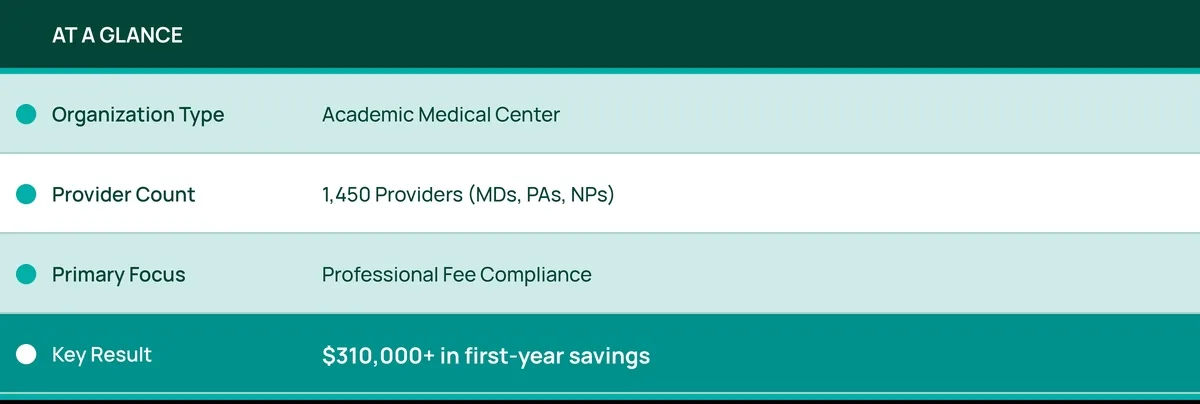
A prominent academic medical center with 1,450 providers—physicians, physician assistants, and nurse practitioners—had built its compliance program around a Retrospective Baseline Probe Audit (RBPA), the industry’s default approach for decades. Every two years, the institution conducted 30-chart audits on 100% of its provider population. On paper, it looked like a comprehensive program. In practice, it was consuming nearly a third of the total compliance budget and covering a fraction of actual exposure.
Four full-time auditing and coding professionals spent the majority of their time executing the RBPA cycle. When the cycle was complete, there was almost nothing left in the budget for the follow-on reviews the findings were supposed to trigger.
The audits were identifying risk the organization couldn’t afford to act on.
The Problem Beneath the Problem
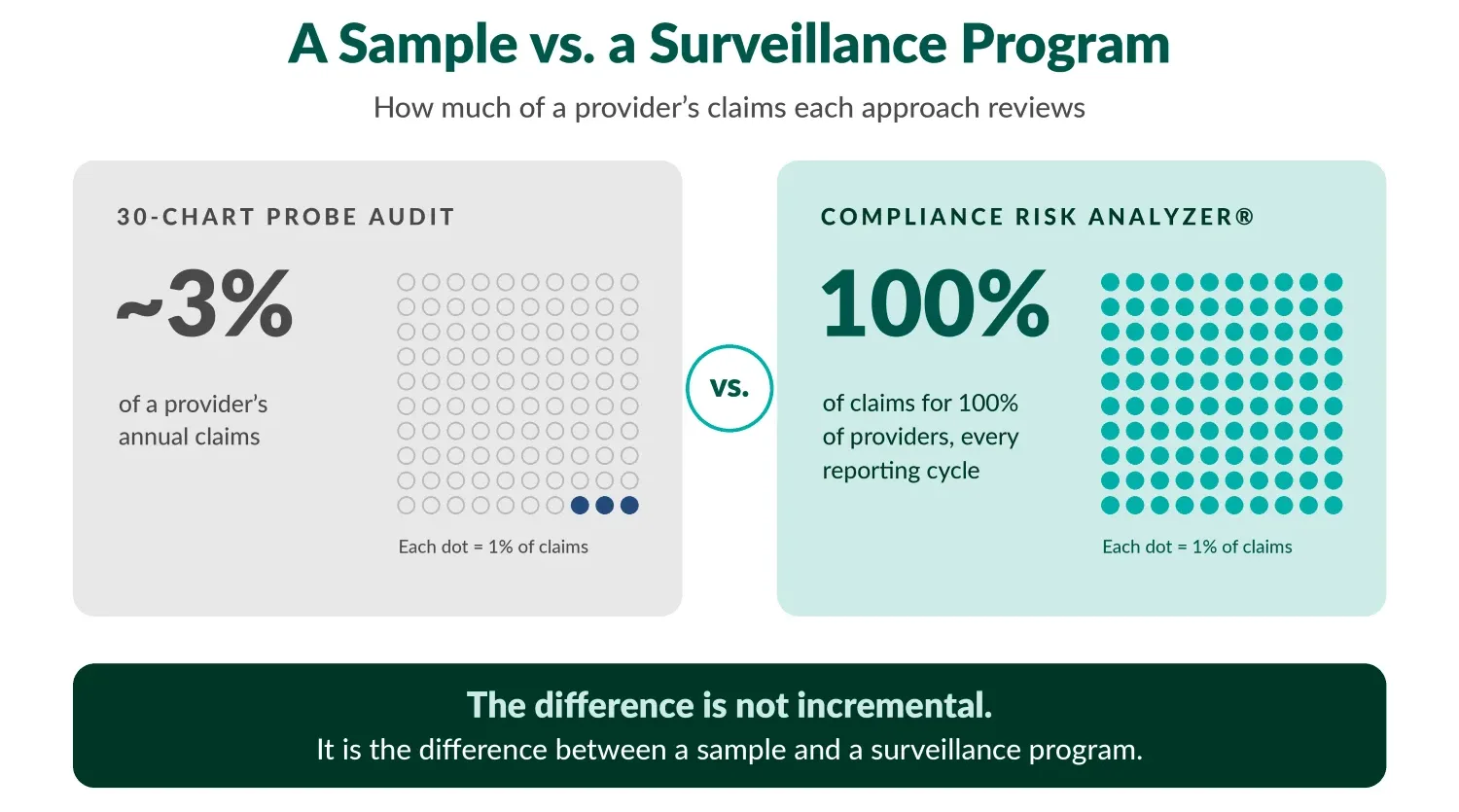
The deeper issue wasn’t cost—it was coverage. A 30-chart audit for a provider who bills 2,400 claims per year and uses dozens of procedure codes is not a compliance program. It is a sample of a sample of a sample, with no statistical basis for extrapolation and significant exposure on every code that was never reviewed.
When external auditors from the Centers for Medicare & Medicaid Services targeted codes the institution had never examined, the compliance team had no data to stand behind. The RBPA wasn’t just expensive. It was generating false confidence.
The Compliance Risk Analyzer® Approach
The institution implemented Compliance Risk Analyzer® as a direct replacement for the RBPA cycle. Compliance Risk Analyzer analyzed 100% of claims across all 1,450 providers—physicians, physician assistants, and nurse practitioners—and every code, every modifier, every provider using the same predictive analytics framework that CMS deploys through the Fraud Prevention System. There was no electronic medical record (EMR) integration and no IT mobilization.
The institution provided 837 claims files in a format it was already producing; Compliance Risk Analyzer did the rest.
The compliance team shifted from conducting random audits to targeted ones. Instead of pulling 30 charts and hoping to find something meaningful, auditors were directing their time and resources to the specific provider-code combinations Compliance Risk Analyzer had already flagged as highest risk—the same patterns most likely to attract external scrutiny.
The result was a compliance program that finally matched the scale of the organization it was supposed to protect.
The Results
The undercoding opportunity reflects Compliance Risk Analyzer’s validated methodology applied conservatively to an 82-provider population, consistent with the validated benchmark of $708 per provider annually at the lower bound of the confidence interval. At that scale, the system pays for itself in the first year many times over from the undercoding recovery alone, before any compliance risk avoidance value is counted.
The modifier findings were resolved through a targeted provider education initiative, internally, before any external audit materialized. Catching something before it becomes a problem is exactly what a proactive compliance program is supposed to do, and exactly what periodic external audits are too slow and too narrow to deliver.
The Claims-Based Compliance Improvement
The financial impact was measurable and immediate.
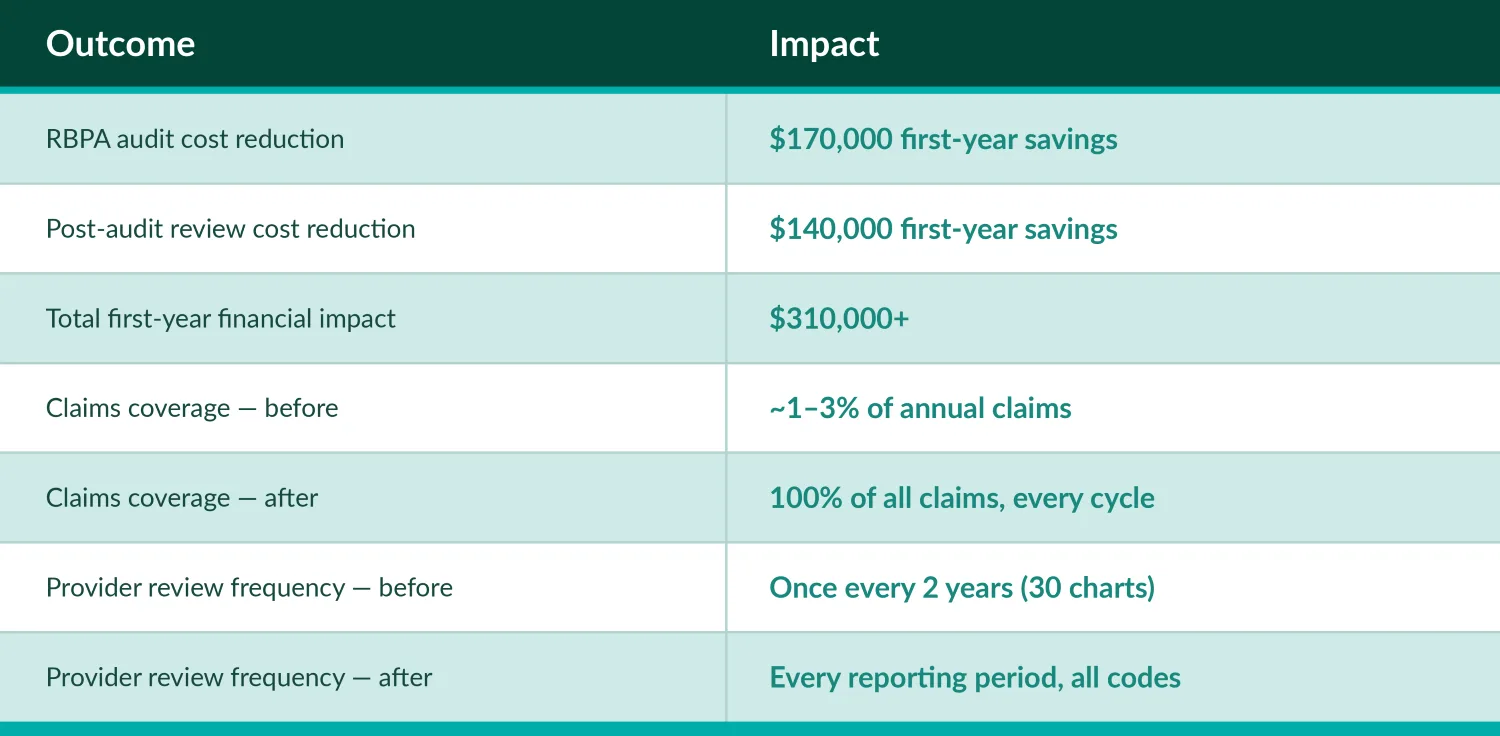
The $140,000 reduction in post-audit review costs was itself a downstream effect of Compliance Risk Analyzer’s precision. The false positive rate collapsed because auditors were no longer chasing chart reviews on codes that turned out to be low risk. Audit time went toward findings that actually warranted action.
More importantly, the compliance program’s posture fundamentally changed.
The organization could now demonstrate to any external auditor exactly what it was monitoring, how it was prioritizing its resources, and why.
That is a materially stronger position, legally and operationally, than a binder of 30-chart samples conducted every two years.
What This Means for Healthcare Organizations Like Yours
For large academic medical centers, the compliance challenge is scale: thousands of providers, hundreds of specialties, millions of claims per year. The probe audit was designed for a world with fewer providers, simpler billing environments, and no analytical alternatives. None of those conditions exist anymore.
Compliance Risk Analyzer was built for this environment. It reviews every claim, flags every risk event, and updates every reporting cycle without adding headcount, without requiring EMR integration, and without the false confidence that comes from believing a 30-chart sample tells you something meaningful about a 2,400-claim provider.

How much revenue is hiding in the claims you never review? Book a demo to stop basing your compliance strategy on a fraction of the story.