The Undercoding Situation
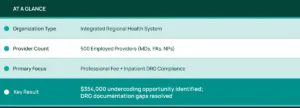
A regional health system with 500 employed providers—physicians, physician assistants, and nurse practitioners—and significant inpatient volume had a compliance program that worked reasonably well for what it could see. The problem was what it couldn’t see.
Professional fee risk was monitored through a combination of periodic audits and ad hoc provider reviews, adequate for the most visible exposure, but silent on the long tail of codes and modifiers that collectively represented the organization’s greatest audit vulnerability. Inpatient DRG risk wasn’t being monitored analytically at all.
When the compliance director looked at her audit plan, it covered the providers she already knew were high utilizers. It said nothing about whether their E/M coding was commensurate with the complexity of their patients, whether modifier usage patterns looked anomalous against specialty peers, or whether the facility’s complication and major complication/comorbidity (CC/MCC) capture rates were leaving documented clinical complexity unbilled.
Two Problems, One Compliance Risk Management Platform, No IT Project
Compliance Risk Analyzer® was implemented to address both the professional fee and inpatient environments simultaneously, through a single data exchange, a single analytical framework, and a single reporting workflow.
On the professional fee side, the software’s proprietary analytics revealed a pattern of systematic undercoding across a subset of the provider population. Providers whose non-E/M procedural complexity was running significantly above specialty averages were coding office visits at or below average—a gap that pointed to recoverable revenue, not a compliance risk. Compliance Risk Analyzer quantified this at the provider level and routed findings directly into an undercoding review workflow.
On the inpatient side, DRG pattern analysis against Medicare Provider Analysis and Review (MedPAR) benchmarks identified a cluster of service lines where CC/MCC capture rates were below peer norms despite above-average length of stay. That pattern is consistent with clinical documentation gaps rather than patient mix differences—conditions that were present but not captured in the medical record. Clinical documentation integrity (CDI) teams were retargeted toward the specific cases and clinical conditions where the documentation opportunity was highest.
No new IT project. No EMR bolt-on. No extended implementation timeline.
The data exchange used claims files the organization was already producing. Compliance Risk Analyzer was generating findings within weeks of engagement start.
Measurable Compliance Analytics Software Results

The undercoding opportunity figure reflects Compliance Risk Analyzer’s validated benchmark of $708 per provider annually, applied conservatively to the organization’s 500-provider population. The labor savings reflect elimination of three upstream audit workflow activities that Compliance Risk Analyzer automates entirely: initial risk identification, audit plan creation, and claims selection.
The inpatient documentation initiative produced measurable CC/MCC lift within two reporting cycles. The precise financial value of that lift is organization-specific and depends on case mix and payer distribution, but the directional impact on DRG weight and reimbursement was positive and sustained.
What Changed for Health System Leadership
For the compliance director, the more significant shift was organizational. She could now walk into a quarterly executive report with a single analytical framework covering both professional and facility billing that is documented, defensible, and updated every reporting cycle. The audit plan was no longer a judgment call. It was a data product.
For the chief financial officer and system leadership, having a unified compliance and revenue narrative that covered both audit risk and undercoding opportunity provided exactly the kind of governance visibility that boards and audit committees expect from a mature compliance program.
What This Means for Healthcare Organizations Like Yours
Regional health systems operate in both the professional fee and inpatient environments, but most compliance programs are built to handle one or the other. Compliance Risk Analyzer bridges that gap, applying the same analytics-driven, risk-based methodology across both domains without requiring separate platforms, separate implementations, or separate data pipelines.
The result is a customizable compliance program that finally reflects the full scope of the organization’s financial exposure, rather than the portion that’s easiest to audit manually. Contact VMG Health to maximize your revenue integrity with Compliance Risk Analyzer.