For over a decade, private equity has played a defining role in reforming physician practice ownership. Across specialties like cardiology, orthopedics, gastroenterology, and ophthalmology, investors built regional and national physician practice management (PPM) platforms through a familiar playbook: acquire a strong platform practice, expand through add-on acquisitions, improve operational and financial performance, with the expectation of an exit within the typical three- to five-year investment period.
Today, that playbook has reached an inflection point. Investment hold periods are stretching well beyond investor expectations, regulatory scrutiny is increasing, and the act of exiting is more complex. These changes indicate that the market is maturing, with long-term platform quality, operational performance, and strategic alignment becoming just as important as acquisition activity.
For health systems, physician groups, and private equity investors alike, understanding the state of the market is critical as new acquisition and partnership opportunities surface.
How the PPM Market Is Evolving
Instead of acquiring and aggregating multitudes of individual practices, private equity investors established a platform practice in a specialty or geography before expanding through a series of regional tuck-in acquisitions. Adding onto a platform in this way enabled organizations to scale, standardize operations, and build negotiation leverage with payers and vendors—all while creating larger enterprises well-positioned in a market.
Although that strategy proved highly successful and accelerated consolidation throughout the physician practice landscape, the market itself has changed as those platforms have matured. The physician landscape remains fragmented and add-on activity continues. What has shifted is the other end of the model: the exit. Platforms built to sell within three to five years are finding a thinner pool of ready buyers, even as the underlying businesses keep scaling.
Now, buyers evaluating these mature platforms must ask themselves whether the traditional playbook will still produce the returns they once expected.
These changes don’t mean physician practice investment has run its course. Instead, they point directly toward a new phase within the market, where operational excellence and strategic positioning matter.
The Exit Environment Is Tightening
The clearest signal of the PPM market’s evolution is one simple metric: investment hold periods. Historically, private equity firms expected to exit their investments within three to five years. Now, private equity–backed assets are taking longer to exit, which may pressure PPM sponsors to plan for liquidity long before an asset reaches maturity.
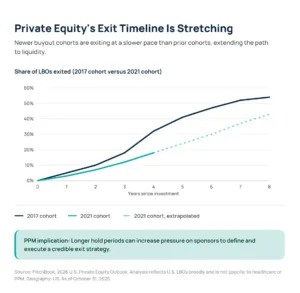
These lengthened hold periods across private equity investments are not the story—they’re the evidence proving the market dynamics around them have changed. There are several factors building this new dynamic:
- Regulatory scrutiny is increasing: States and federal policymakers are paying closer attention to healthcare transactions involving physician practices, especially those including management services organizations. States like New York and Minnesota have expanded pre-close notification and review of healthcare transactions, and in January this year, California enacted similar oversight of private equity in medicine—raising the diligence bar and lengthening timelines for deals involving management services organizations.
- Value creation is changing shape: Add-ons are no longer enough; many organizations are prioritizing the improvement of operational performance, infrastructure, and organic growth within existing platforms. Depending on the specialty and platform, value take many forms, from practice-related asset buildouts and infrastructure for assuming risk to improved performance through scale and modernization.
- Interest rates are stable, but still high: The financing environment is tightening as interest rates remain elevated compared to the near-zero-rate environment of 2020–2021, and buyer expectations continue to evolve for a more selective transaction process
While many PPMs continue to build scale through tuck-in acquisitions and work to improve financial performance of the existing business, the traditional sponsor-to-sponsor exit is becoming harder to execute as buyers grow more selective and financing costs remain elevated.

More financial sponsors are using alternative structures to create liquidity without a full sale.
These approaches can return capital to investors while extending the hold period, giving sponsors more time to improve performance and wait for a stronger exit market. But they are bridges, not solutions to a challenging exit environment.
That leaves the strategic sale, the exit drawing the most attention today. Strategic buyers fall into three broad categories:
- Distributors and supply chain acquirers: Companies extending downstream from products and services into care delivery.
- Payers and payer-aligned platforms: Insurers and their subsidiaries integrating vertically to own the physician relationship.
- Health systems: Acquiring for geographic density, network completeness, and referral alignment.
It’s that last category—health systems—where private equity may find its next strategic buyer. And we’ve seen this blueprint before.
What’s Next: The Urgent Care Playbook as a Window to the Future
The PPM market is moving toward a different model of value creation. As traditional exits are delayed, strategic buyers like health systems may play an important role in the next phase of physician practice transactions. Well-developed regional PPM platforms that can complement existing health systems through geographic, operational, and network alignment could be attractive acquisition opportunities to a health system acquirer.
Future buyers may place greater emphasis on platform quality and strategic fit, as the urgent care market suggests. Urgent care has already undergone this transition, with private equity firms building regional care platforms through acquisition—and health systems emerged as the strategic buyer in certain markets. As PPM platforms continue to mature, their next chapter may look quite similar to that of urgent care.
In our next article, we’ll explore what the urgent care market reveals about the future of physician practice exits—and what health systems should watch as similar opportunities begin to emerge.
 Understanding today’s market dynamics is essential for evaluating tomorrow’s opportunities. Connect with VMG Health to navigate evolving healthcare transactions with confidence. “`html
THE Physician Practice Management SERIESKeep the Conversation GoingExplore four perspectives on the changing physician practice management landscape, from private equity trends to alternative buyers. |
|||
|
01 Private Equity in Physician Practices: PPM Is Changing Explore how the physician practice management landscape is changing and what comes next. |
02 Is the Urgent Care Exit Playbook the Blueprint? What could urgent care transactions reveal about the future of PPM platforms? |
03 One Less Bidder: What Optum’s Retreat May Mean Examine what Optum’s retreat could mean for private equity–backed physician practices. |
04 Could Strategic Health System Buyers Rewrite the Exit Playbook? Investigate whether and when a strategic health system buyer offers an alternative to a traditional PPM platform. |