
A full appointment book can make medical aesthetics practice owners feel successful. Providers are treating patients, delivering services, and potentially generating more revenue. Yet a busy schedule does not always translate into greater profitability.
Understanding the difference between being busy and being profitable requires looking beyond total sales. What does each treatment contribute after accounting for its variable costs? How effectively is appointment time being used? Are promotions generating additional business, or are they simply discounting visits that would have occurred anyway?
Examining these questions can help practice leaders make informed decisions about pricing, scheduling, and growth while maintaining a strong patient experience.
What Does Each Treatment Contribute to the Practice?
A treatment’s selling price tells a practice how much revenue it may generate, but it does not explain how much that service contributes to the practice’s profitability. Two treatments with similar prices can produce different financial results depending on product cost, consumables, promotions, and time requirements.
Understanding Contribution Margin in Medical Aesthetics
Contribution margin is the amount remaining after subtracting variable costs from net treatment revenue. That amount helps cover fixed expenses, such as rent, payroll, insurance, and marketing. Once those expenses are covered, the remaining contribution supports operating profit.
Consider this simplified hypothetical comparison. Both treatments generate $400 in total revenue but have different costs. For an accurate contribution margin comparison, include provider production-based compensation as a variable cost when applicable, since differences in compensation may affect the profitability of each treatment. This example excludes provider production compensation, but you may choose to add it to your calculations.
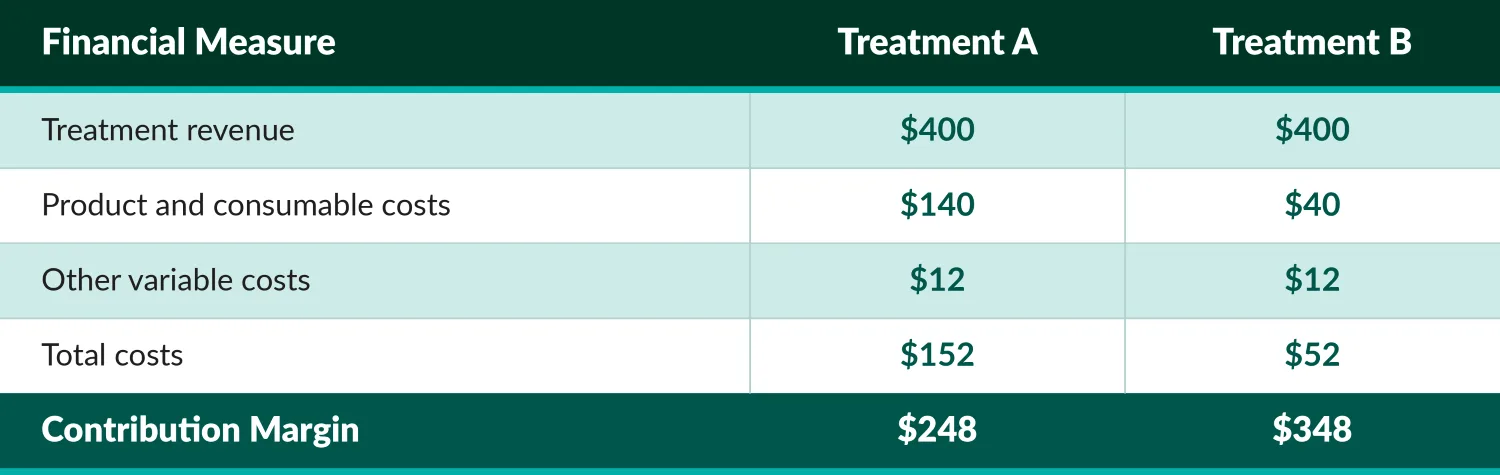
Although the treatments generate identical revenue, Treatment B contributes $100 more per appointment toward overhead and profit. Focusing only on sales would obscure that difference.
Contribution margin is not the same as net profit. The $248 remaining from Treatment A still needs to help pay the practice’s fixed expenses.
A practice can deliver treatments with positive contribution margins but remain unprofitable if total contribution is insufficient to cover overhead.
Is the Appointment Schedule Being Used Effectively?
Treatment economics also depend on time. In medical aesthetics, appointment length is often viewed as a reflection of the patient experience. A practice may schedule an hour for a treatment because it wants patients to feel heard and cared for. That intention is valuable. However, practice leaders should examine whether the additional time consistently improves the experience or has simply become a scheduling habit.
Consider two practices offering the same treatment: One schedules 60 minutes, while the other schedules 30 minutes. The longer visit might include a comprehensive consultation or thoughtful treatment planning, depending on the patient’s needs. A shorter appointment might reflect a well-prepared team and an efficient workflow. Neither appointment length, by itself, demonstrates quality or efficiency.
The question is what happens during those minutes. Practices should distinguish between time needed for safe clinical care, time that adds value to the patient experience, and time devoted to interactions that may not require an extended appointment.
 Evaluating Contribution per Hour
The financial implications of appointment length deserve attention. A treatment generating $300 in revenue produces $300 per scheduled provider hour when the appointment lasts 60 minutes. If the appointment lasts 30 minutes, the same treatment could generate $600 per scheduled provider hour if both slots are filled.
Incorporating contribution margin provides a more useful comparison. In the earlier example, if Treatment A requires 30 minutes and Treatment B requires 60 minutes, their contribution margins per hour would be $496 and $348, respectively, assuming the practice can fill the available appointment slots. Actual results will depend on patient demand and schedule utilization.
Treatment B has a higher contribution margin per visit, while Treatment A has a higher contribution margin per hour. Both measures help explain the financial role of a service.
A longer appointment may be appropriate for a new patient or a complex treatment. A returning patient receiving a familiar service may need less time. Appointment lengths should reflect those differences, along with patient expectations and the economics of the service.
Promotions: Does the Offer Generate Additional Business?
Pricing decisions connect treatment contribution with schedule utilization. A promotion can fill unused appointment time or encourage patients to try a new service or return for additional care. Its financial value depends on whether it generates business that would not otherwise have occurred and whether that business contributes enough to justify the offer.
For example, discounting a treatment from $400 to $350 reduces revenue by $50 per visit. If 40 patients who would have paid full price receive that discount, the practice gives up $2,000 in revenue before considering additional expenses. At the discounted price of $350, the practice would need approximately six incremental appointments to recover that revenue on a gross revenue basis. But the actual break-even point will depend on the contribution margin of those additional visits, including any variable costs associated with providing the treatment. This distinction helps practices evaluate whether a promotion is generating enough additional business to offset the discounts offered to existing patients.
The purpose of the promotion matters. An offer that fills available capacity may serve a different purpose than one that discounts an already full schedule. When the schedule is full, discounted appointments may also displace full-price visits.
Before launching an offer, practices should define its objective. Is the goal to fill a slower period, introduce a service, reactivate patients, or encourage appropriate treatment continuity? Practices should evaluate incremental completed appointments, contribution margin after discounts, and subsequent patient visits—not simply total sales.
Turning Activity Into Financial Performance for Medical Aesthetics Practices
Treatment contribution margin, appointment time, and promotional pricing are interconnected. A service may contribute a substantial amount per visit but require considerable clinical time. Longer appointment times may reduce the number of available slots on a provider’s schedule. A promotion may increase bookings while reducing the schedule’s overall financial contribution.
Reviewing these factors together gives practice leaders a stronger basis for decision-making. A practical starting point is to evaluate a few core services and determine total revenue, identify variable costs, calculate contribution per visit and per scheduled hour, and assess how discounts change the result.
The objective is to understand the financial role of each service and use that knowledge to guide pricing, promotions, and scheduling. A full schedule signals strong patient volume. Understanding how those visits contribute to financial performance allows a practice to manage growth with greater confidence.

A busy schedule is only one measure of practice performance. VMG Health helps medical aesthetics practices evaluate service-line economics, pricing, and operational performance to make informed decisions about profitability and growth.