
Health systems that own health plans typically know their payer mix, medical loss ratio (MLR), and delivery-system margin. What many do not know is the economic value of a member who is enrolled in the system’s health plan and primarily receives care from the system’s providers.
That distinction can change how leaders view the health plan. Rather than evaluating it only as a standalone business, an Aligned Member Economics Analysis can measure contribution margin at the member level and consider the value created across the broader enterprise. Although MLR is an important plan metric, it does not capture the full economics of a member relationship that spans the payer and provider sides of an integrated organization.
The Opportunity: Understanding the Value of an Aligned Member
For a provider-sponsored health plan, an “aligned member” is enrolled in the health system’s plan and primarily uses the health system’s broader portfolio of care and services, including primary and specialty care, outpatient facilities, pharmacies, post-acute services, and other owned or affiliated assets. This structure gives health systems an opportunity to evaluate the member relationship across the enterprise, rather than viewing health plan and delivery-system performance separately.
By comparing the contribution margin of aligned and unaligned members, leaders can begin to understand whether alignment is creating additional enterprise value.
The value of alignment may also extend to quality. Industry data suggests provider-integrated plans often perform well on Medicare Advantage (MA) Star Ratings. For example, Alliance Community Health Plans (ACHP) members accounted for nearly 20% of enrollment in 2026 contracts rated 4 Stars or higher. The more important question for any individual plan is whether its own aligned members outperform its unaligned members on quality measures.
If they do, growing aligned membership becomes a quality strategy in its own right: Shifting the plan’s membership mix toward aligned lives can lift contract-level Star performance and the quality bonus payments that follow, without investing in measure-by-measure improvement. Measuring that performance gap, and how much of it persists as new members align, tells leaders how much enterprise effort to put behind capturing aligned lives.
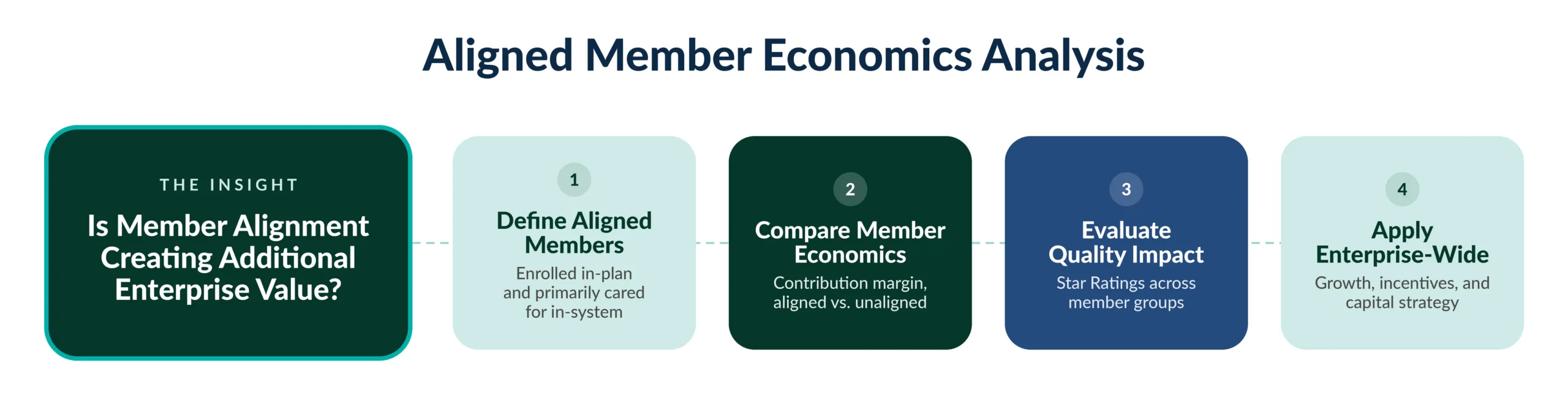
The analytical challenge is that health systems frequently manage profit-and-loss (P&L) statements for their plan and delivery-system separately, meaning leadership may not have a member-level view that connects plan economics with the value generated when that member uses the health system’s broader portfolio enterprise, often in ways that differ from non-aligned members. Without that enterprise view, decisions about growth, pricing, provider strategy, and capital may be based on an incomplete picture of member economics.
What Changes When Leaders See Member Economics Data?
Once leadership understands the economics of aligned members, several strategic decisions may look different:
Growth & Pricing
Once leaders understand the economics of aligned membership, growth becomes an enterprise consideration rather than solely a health plan objective. Provider-sponsored health plans have the potential to capture value from both the insurance and care-delivery sides of the member relationship, giving health systems greater influence over the premium dollar and greater visibility into the economics of membership across the enterprise. That member-level view can inform MA bid submissions and commercial payer pricing strategies by helping leaders assess the full economic value of a member relationship—not just the health plan’s margin in isolation.
Provider Incentives & Clinical Integration
Member economics can also inform how a health system structures care management and provider incentives. The relationship between a provider-sponsored plan and its health system can create opportunities to connect claims and clinical information and coordinate care more closely between primary care providers and specialists. Instead of leaving utilization management, care coordination, risk adjustment, and transitions of care primarily on the plan side, organizations can assess where those capabilities are most effective across the enterprise.
For aligned providers, understanding the economics of the member population can inform risk-sharing arrangements, incentive structures, and other contracting decisions designed to align provider performance with the financial and quality outcomes of the health plan and broader enterprise. These considerations can also inform MA bid strategy when health systems assess how provider incentives and risk arrangements may affect the cost and performance of the aligned population.
Capital Strategy
Growth also carries a capital requirement. The National Association of Insurance Commissioners describes risk-based capital (RBC) as a statutory capital minimum, relative to an insurer’s size, that must be maintained to absorb the inherent risk of its assets and operations. When leaders understand the lifetime economics of aligned membership, they can evaluate regulatory capital alongside the expected enterprise return instead of treating capital solely as a health plan requirement.
These decisions require an enterprise perspective. Provider-sponsored health plans hold a unique position within health systems, connecting the economics of insurance with the economics of care delivery. Because the same organization may bear financial risk on both sides of the transaction, evaluating the health plan solely on its own P&L can obscure value created, or costs incurred, elsewhere in the enterprise. An enterprise-level view of member economics can bring those relationships into focus, allowing leaders to evaluate the health plan alongside downstream utilization, provider economics, and other system-level effects.
Member Alignment Does Not Guarantee Enterprise Value
Owning a health plan does not make these benefits automatic. Successful health plan operations require capabilities and disciplines that differ from those of a delivery system, including actuarial and underwriting expertise, risk management, and sufficient capital and scale.
The financial pressure on provider-sponsored plans is real. A 2026 study in Health Affairs Scholar found that provider-sponsored issuers in Affordable Care Act Marketplaces had MLRs 5.8 percentage points higher than traditional issuers, while also reporting higher overall quality ratings. Organizational structure may shape how MLR is interpreted—an important consideration for health systems evaluating an owned health plan’s performance. Financial results may not capture the full value it creates across the enterprise, from downstream care delivery to other system assets.
Without measuring member economics across the organization, leaders can’t see that value clearly.
Alignment creates an opportunity for health systems, and realizing its value requires organizations to measure and actively manage the economics of plan ownership. A plan can perform poorly on a standalone basis while contributing value elsewhere in the enterprise, or it can grow membership without creating sufficient enterprise return. Leadership needs detailed analysis to distinguish between those outcomes.
Start With the Economics
Health system and health plan leaders should start by asking a basic question: Have we ever measured the economics of our members this way? Comparing aligned and unaligned member economics can show where the enterprise is creating or losing value and help leadership prioritize opportunities in growth and pricing, provider contracting, clinical integration, or capital efficiency.
VMG Health’s Aligned Member Economics Analysis measures contribution margin and lifetime value across aligned and unaligned members, giving health systems a clearer view of where payer-provider relationships create enterprise value. If your organization has not conducted an aligned member economics analysis, VMG Health can establish a baseline, identify the most significant opportunities, and inform your next strategic decision.