
What Comes After a New Access Point Award?
A New Access Point (NAP) award is a major milestone, but it is only the starting line. From the date of your Notice of Award, you have a defined window to open your proposed sites, deliver every required service, and prove compliance with the Health Center Program. Knowing what comes next, and in what order, is what turns an award into a sustainable access point for your community.
The work is not the same for everyone. NAP cohorts include three very different groups: existing grantees adding a site, Look-Alikes converting to full grantee status, and a smaller number of brand new organizations. In the most recent cohort of 158 awardees, only eight were true brand new organizations. What you must do next depends on which group you are in.
This guide breaks down what a NAP award actually means, what each group should prioritize, and the practical steps that keep you compliant and financially strong through year one and beyond.
What Is a New Access Point Award & What Does It Mean?
A New Access Point award is federal Section 330 grant funding under the Health Center Program. Once you accept it, you are committing to a defined set of obligations, and HRSA expects fast results.
Within 120 days of your award, you must:
- Open and operate all proposed sites in your approved scope.
- Deliver all required services, including behavioral health, on your Form 5A.
- Demonstrate compliance and pass an Operational Site Visit (OSV) if one is scheduled.
- Verify each site in the HRSA Electronic Handbooks (EHBs) as it opens.
The deadline is not a suggestion. If you miss it, HRSA can place a condition on your award and give you up to 120 additional days to resolve it. Leave that condition unresolved, and HRSA can terminate the award altogether. Losing the grant does not just cost you the awarded $650,000: A suspended or terminated award can also cost you Federal Tort Claims Act (FTCA) coverage, 340B Program pricing, and your enhanced Prospective Payment System (PPS) reimbursement.
Know Your Starting Point: Three Paths from Award to Execution
Most of this cohort is not building from scratch. Understanding your path is the first step to a realistic plan.
1. Existing Grantees Adding a Site
You already know the drill. Your new site folds into your existing project period, and you should already be meeting Health Center Program requirements. Your focus:
- Add the new site and any new services to your scope of project on Forms 5A, 5B, and 5C.
- If your actual site differs from the one you proposed, confirm it sits within the same ZCTA (service area), or pursue the proper permissions.
- Determine whether the expansion qualifies you for a PPS rate adjustment.
2. Look-Alikes Converting to Grantee
Even if you have been following the compliance rules, converting to a grantee adds new financial machinery and a few new obligations. Your focus:
- Learn to manage H80 grant funds and Payment Management System (PMS) drawdowns.
- Update your policies and procedures to include federal cost principles, procurement, and grant tracking.
- Update your cost report and grant number and coordinate carefully on 340B to ensure continuous coverage without having to re-register.
- Prepare for FTCA. The application window is not always open, so evaluate your processes and procedures to ensure you meet FTCA requirements. Gather your documentation now and be ready when the application window opens.
- Meet monthly. Your board meetings, minutes, and financial documentation matter more than ever after you win a NAP Award.
3. Brand New Organizations
You have the heaviest lift: standing up governance, systems, and staffing while working toward first-time compliance in 120 days. New organizations receive a one-year project period, with continued funding tied to proving compliance. Your focus:
- Build your governance structure, policies and procedures, and compliance plan.
- Learn to manage H80 grant funds and PMS drawdowns.
- Prepare for FTCA. The application window is not always open, so evaluate your processes and procedures to ensure you meet FTCA requirements. Gather your documentation now and be ready when the application window opens.
- Ensure your revenue cycle, billing, and credentialing processes are set up to bill appropriately for your new Federally Qualified Health Center (FQHC) status.
- Move aggressively on staffing amid a national healthcare workforce shortage, and think creatively about your care model.
- Set your initial PPS rate deliberately because it will shape your finances for years.
New organizations should take heart: This is a heavy lift, but it is doable. HRSA extends grace to first-year organizations that stay engaged.
Use your project officer and reviewers as a resource and lean on peers and advisors who have launched a health center before you.
How to Read Your Notice of Award: Treat It Like a Contract

Your Notice of Award (NOA) is easy to file away and forget. Do not. It is the single most important document you now hold, and it spells out:
- Funding Parameters: Award amount, budget period, and allowable costs
- Terms & Conditions: Exactly what you are committing to
- Reporting Obligations: Federal Financial Reports (FFR), UDS, and progress reports
- Conditions of Award: Each with a response deadline you must calendar
- Key Contacts: Your project officer and grants management specialist, named on the document, whose permission you need for budget or project changes
Read every word, including footnotes and any updated versions. You will receive a new NOA each time HRSA removes a condition, so treat the original as your to-do list and each revision as progress. If you are not receiving them, check your spam folder and your HRSA EHBs, then download and date-stamp each version. Your auditors and cost-report preparers will ask for them later.
“Your Notice of Award is your contract with the government. Do not file it away to read later. It is your to-do list, and every condition and deadline in it matters.”
– Elizabeth Burrows, JD, Managing Director, FQHC & Community Health, VMG Health
How to Protect Your First-Year Prospective Payment System Rate
Your PPS rate is the per-visit Medicaid payment that will fund your operations for years. Getting it right early is one of the highest-value moves you can make. Every state has a different process for calculating and approving PPS rates.
For current FQHCs and Look-Alikes adding a site or service:
- Ask whether you qualify for a change in scope that supports a higher rate. Rules vary by state, so this may or may not be the moment for an increase.
- Capture all applicable costs.
- Enroll every new site. If a new site is not enrolled, you will not receive the PPS rate for it.
For new FQHCs setting an initial rate:
- Learn your state’s PPS methodology, timeline, and enrollment rules. Many states set an initial rate, then reconcile after a tracking period. A rate set too low can leave money on the table or trigger a payback later.
- Report your Medicare cost report accurately, as it can feed the Medicaid rate.
- Enroll as an FQHC with Medicare under Part B, build your G-code fee schedule, and review your charge master so that charges support PPS and avoid “lesser of charge or PPS” limits.
This is where instinct can work against you.
Efficiency is a virtue in most operations, but in your first year, fully capturing your costs enables you to lock in the strongest possible rate. It feels backwards, and it carries real, long-term sustainability implications.
Even one dollar more per Medicaid visit can add up quickly; across a full patient panel, it can mean six or seven figures a year in additional revenue for your community.
Manage Your Grant Draws & Document Everything
If there is one word to carry through year one, it is documentation. Federal grant dollars come with strict handling rules, and drawing funds without adequate documentation can leave your organization scrambling to justify expenses, repay funds, or answer to auditors. Disciplined grants management starts before your first drawdown, so set your controls up before you need them:
- Open your PMS account early and set your draw cycles.
- Draw only for actual, immediate needs—never to park cash for future costs. Overdrawing can put you on drawdown restriction, which means more paperwork and slower access to your money.
- If you draw ahead of an expense, disburse within a few days. The commonly cited best practice is 48 hours.
- If cashflow allows, draw after you spend so that every draw is already backed by an expenditure.
- Track federal funds by source and expenditure in your accounting system, with supporting documentation filed as you go.
- File your Federal Financial Reports through PMS on schedule. There is far less grace for late submissions than there used to be.
The best use of grant funds is usually payroll, which carries lighter procurement documentation requirements than purchasing. When you do buy goods or services, follow your procurement policies to the letter, and train everyone in the purchasing chain, not just the Chief Financial Officer.

Remember that capital purchases carry federal interest and long-term reporting obligations that can outlast the item’s usefulness, so a car or piece of equipment bought with grant funds can become a liability you cannot easily retire.
“If your grant gets suspended, you lose FTCA, you lose 340B, you lose PPS. You lose all the benefits that make being an FQHC worth it. So do not mess with your grants.”
– Amy Brisson, Managing Director, FQHC & Community Health, VMG Health
Do Not Leave FQHC Benefits on the Table
The award is worth far more than the grant dollars. Once you are a grantee, make sure you are capturing the full value of FQHC status:
- Enhanced Medicaid reimbursement through your bundled PPS per-visit rate
- 340B Drug Pricing on outpatient prescriptions, often a larger revenue source than grants when implemented well
- FTCA medical malpractice coverage for the health center once deemed
- National Health Service Corps access, including automatic Health Professional Service Area consideration and loan repayment that helps recruit and retain clinicians
- Medicare FQHC payment and cost-based benefits
- A sliding fee program that serves uninsured and underserved patients
- Additional funding from federal, state, foundation, and local sources, plus programs like Vaccines for Children
Diversifying revenue is not optional. HRSA wants health centers to build multiple streams, and your community depends on your doing so.
Find Your First-Year Operating Rhythm
Once the doors are open, sustainability comes from rhythm. Five areas deserve standing attention:
- Staffing & Care Model: Recruit, credential, and retain your team, and think creatively—adding medical assistants and nursing staff can expand capacity when providers are scarce.
- Revenue Cycle: Bill and collect PPS, 340B, and sliding fee correctly, and watch for preventable losses like stalled prior authorizations.
- Governance: Hold a board meeting every month with quorum, and keep your finance and quality committees active, especially if you are pursuing FTCA.
- Quality & Uniform Data System (UDS): Capture clean patient data and track every measure against the current UDS manual.
- Ongoing Compliance: Stay audit-ready between site visits, and run internal audits on sliding fee, procurement, and patient check-in.
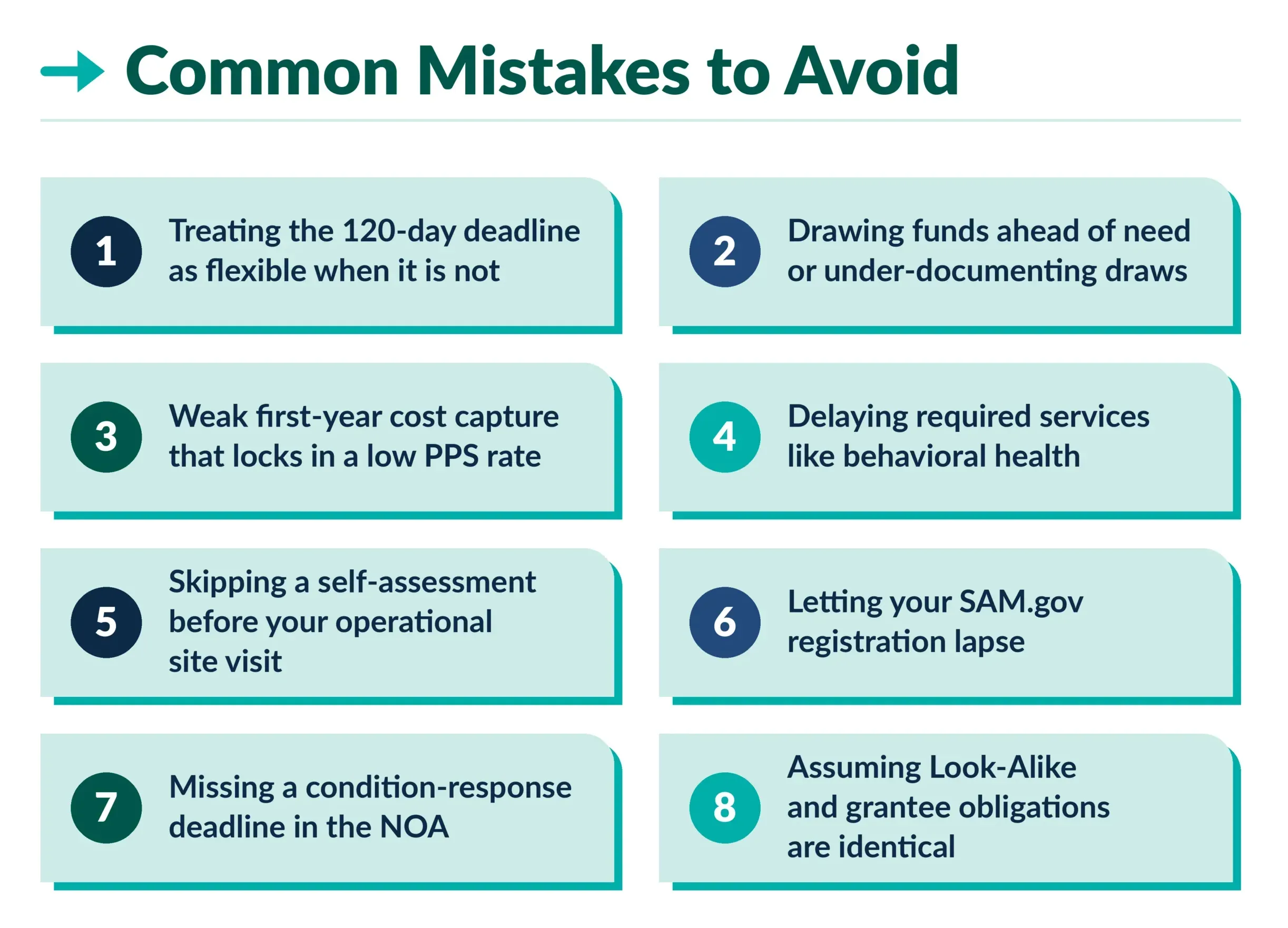
These stumbles that most often trigger conditions, audits, and lost funding.
Your Early Priorities: A Quick NAP Award Checklist
- Read the NOA and calendar every condition deadline.
- Set up your PMS account and financial controls.
- Drive the operational build to hit your 120-day open date.
- Self-assess against the Health Center Program requirements ahead of your OSV.
- Protect your first-year PPS rate through disciplined cost capture.
The Bottom Line: You Are Not Alone
A NAP award is a rare and meaningful opportunity to bring care to a community that needs it. The first 120 days are demanding, but they are absolutely doable, especially when you know your path and prioritize accordingly.
Read your award closely, implement your financial controls early, capture your costs, and lean on people who have done this before.
The biggest winners are the patients in your community, who will now have access to care they might not otherwise receive. If you set up for your NAP award correctly, you build a foundation that serves them for years. Health centers that proactively interpret their Notice of Award, implement financial controls, capture costs to protect their PPS rate, and prepare for the operational site visit will be better positioned to open on time and safeguard access to care.
The organizations that navigate this transition successfully will be the ones building their approach now, not scrambling once the site visit is on the calendar.

Every health center’s path from award to execution looks different. Partner with advisors who have sat on your side of the desk. The teams from Community Link Consulting and Burrows, now part of VMG Health’s FQHC & Community Health Practice, can help you build lasting strategies that support your success.