
The Centers for Medicare & Medicaid Services (CMS) released its 2027 Hospital Outpatient Prospective Payment System (OPPS) and ambulatory surgery center (ASC) proposed rule on July 2, and the headline numbers are significant enough that hospitals, ASCs, and 340B participants should be running their own financial models now—before the comment period closes on August 31.
Here’s what’s in the proposed rule and how those changes could impact your organization.
A Major Cut: 340B Drug Pricing Program Changes
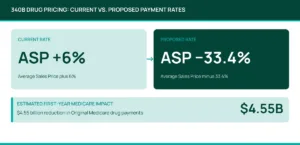
The most consequential provision for many health systems is the proposed overhaul of 340B Program payment rates. CMS is proposing to pay for 340B-acquired drugs at average sales price minus 33.4%, a sharp reduction from the current rate of average sales price plus 6%. The agency conducted an acquisition cost survey and estimates this change would reduce Original Medicare drug payments by roughly $4.55B in the first year alone.
For 340B-participating hospitals—many of which being disproportionate share, safety net, or rural facilities—this isn’t an abstraction. The 340B Program exists specifically because these organizations serve high proportions of low-income and underserved patients. A payment rate that drops this far below acquisition cost for some drugs puts real operational pressure on programs that depend on that margin to cross-subsidize services. Hospital groups immediately condemned the proposed cut, with the American Hospital Association calling it “unlawful,” while America’s Essential Hospitals claimed that its faulty methodology was built from a survey with an inadequate sample size. CMS will collect comments for 60 days.
Tightening the squeeze, CMS also wants to accelerate its recovery of $7.8B in extra, non-drug payments that hospitals received under the prior 340B policy from 2018–2022, proposing to raise the annual clawback offset from 0.5% to 3% in 2027. At that pace, the full recovery would be complete by 2029.
Site-Neutral Payments Keep Expanding
CMS is expanding site-neutral payments again, this time to imaging services without contrast (e.g., X-rays and MRIs) delivered in off-campus, provider-based departments. The agency would pay physician office rates rather than the higher hospital outpatient rates, estimating roughly $260M in first-year Medicare savings.
This is part of a deliberate, multi-year pattern. Site-neutral payment expanded to drug administration in 2026; it’s now reaching imaging in 2027. The trajectory seems to point toward surgical services next. For health systems that have built or acquired off-campus, provider-based departments as a growth strategy, the financial case for that model may be eroding.
ASCs & Hospitals Get a Rate Bump—With a Catch

Regarding revenue, CMS is proposing a 2.4% payment update for both hospital outpatient departments and ASCs that meet quality reporting requirements, based on a projected 3.2% market basket increase reduced by a productivity adjustment.
For ASCs, the continued expansion of the ASC Covered Procedures List (CPL), combined with the ongoing shrinkage of the inpatient-only list, creates real opportunity to capture additional case volume. The proposed rule discusses adding 618 surgical procedures to the ASC CPL and removing an additional 637 procedures from the Medicare Inpatient Only list. ASCs may find this change to be a meaningful positive in an otherwise challenging rule for many providers, even as prior authorization expansion continues.
Prior Authorization & Price Transparency: Watch These Closely
Citing a 42.8% jump in claim volume from 2017–2024, CMS is proposing prior authorization requirements for another eight botulinum toxin injection codes in the hospital outpatient setting:
- Medication HCPCS Codes:
- J0585
- J0586
- J0587
- J0588
- J0589
- Procedure Codes:
- 64162
- 64615
More broadly, the agency issued a request for information (RFI) on tightening machine-readable price transparency file standards, specifically asking how hospitals report contract mechanisms like stop-loss provisions, rate tiering, and carve-outs. Although the RFI is not currently a final rule, organizations that haven’t already gotten serious about price transparency compliance should consider it a preview of what’s ahead.
What You Need to Understand Right Now
For Hospitals
The combination of 340B cuts, site-neutral expansion, and an accelerated clawback offset creates compounding margin pressure. If your organization participates in 340B and operates off-campus, provider-based departments, this rule warrants a focused financial impact analysis.
For ASCs
The rate bump and procedure list expansion are genuine tailwinds. Even so, watch the prior authorization expansion closely for downstream effects on case mix and volume.
For 340B Participants
This is not a settled question. The proposed acquisition cost methodology is being contested by hospital groups on legal and technical grounds. We are monitoring its development through the comment period and any subsequent litigation. The 60-day comment period is also a real opportunity to push back on specific provisions. CMS will accept comments through August 31.
VMG Health works with hospitals, ASCs, and physician practices navigating exactly these kinds of reimbursement shifts, whether that’s modeling the financial impact of site-neutral expansion, supporting strategic decisions around service line positioning, or preparing for a transaction in a changing payment environment.

If this proposed rule raises questions for your organization, we’re eager to help you think through them. Reach out to our experts for bespoke support that helps finance, strategy, and operational leaders turn regulatory change into informed decision-making.