For more than a decade, Optum has been one of the most influential strategic buyers in the physician practice management (PPM) market. Created in 2011 through consolidation of UnitedHealth’s existing services, Optum’s quiet but aggressive acquisition strategy focused largely on primary care. It grew into the nation’s largest employer of physicians, with approximately 90,000 employed or affiliated physicians at its peak.
Today, however, the story has shifted from acquisition to repositioning and all the way to divestiture.
Optum’s decision to reduce its physician footprint is more than a company-specific strategy shift—it reflects a broader shift in healthcare as payers, health systems, physician groups, and private equity sponsors reassess where to deploy capital. For the PPM market, there’s a larger question:
What happens when one of its largest and most aggressive buyers becomes significantly more selective?
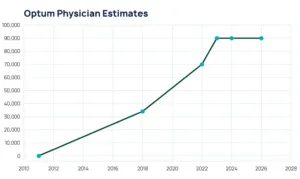
Sources: beckershospitalreview.com; statnews.com
How Optum’s Physician Practice Strategy Has Changed
Optum built its PPM platform around the belief that combining physician ownership with insurance products and value-based care would generate long-term returns. But recently, financial pressures have mounted. Rising healthcare utilization, network management, patient preferences, and other factors have all contributed to increased medical loss ratios; UnitedHealth experienced weaker financial performance; and leadership changes coincided with heightened regulatory scrutiny.
Recently, UnitedHealth Group announced a deal to sell Florida-based Optum clinics to TPG Inc., a private equity firm. UnitedHealth plans to shift its focus to value-based care and deals supporting OptumInsight.
 That strategy brings the long–standing tension between physician autonomy and value-based care into sharper focus. Physicians are trained to be independent thinkers and staunch advocates for their patients—the challenge of migrating from fee-for-service to delivering incremental value while preserving physician autonomy continues to be tested, as Optum experienced, with varied results.
Before examining the drivers behind Optum’s strategic shift, it’s helpful to understand the scale of the changes already underway.
Optum’s Strategic Reset by the Numbers
| Metric | What’s Changing | Why It’s Important |
|---|---|---|
| Physician Network | Approximately 90,000 employed or affiliated physicians at peak | Established Optum as one of the nation’s largest strategic buyers of physician practices. |
| Affiliated Provider Network | Planned reduction of ~20% | Signals a shift from aggressive expansion to portfolio optimization. |
| Care Sites | Approximately 550 care sites are being closed or divested | Demonstrates that the pullback is operational—not simply a change in strategy. |
| Operating Performance | UnitedHealth’s operating margin declined to 2.7% in 2025, compared to 5.2% in the previous year. | Financial pressure has accelerated efforts to rationalize the physician portfolio. |
| Patients Served | Second-quarter 2026 revenues of $23.5B decreased 5% year-over-year due to ~700,000 fewer value-based care patients served. | Indicates that revenues and the number of patients are shrinking in 2026. |
These metrics illustrate that Optum’s retrenchment is not theoretical—it is already reshaping its operating platforms across multiple markets. Rather than continuing the rapid expansion that defined the past decade, Optum now appears focused on optimizing its existing portfolio.
What the Optum Shift Could Mean for PPM Exit Strategy
Historically, PPM sellers benefited from three primary buyer groups: private equity sponsors, health systems, and buyers like Optum.
Each brought different investment objectives. Private equity sought operational improvements and eventual exits. Health systems pursued physician alignment and market expansion. Optum operated differently, using its integrated payer, provider, and value-based care capabilities to pursue a broader model of value creation than standalone physician practice earnings.
Whether those expected returns failed to materialize or management became more disciplined, the practical effect is the same: One of healthcare’s largest buyers will likely compete less aggressively for physician practices. That changes the economics of the transaction market.
Implications for Private Equity & Health Systems
For private equity sponsors, Optum has long represented an important strategic exit option. If another financial sponsor wasn’t interested in acquiring a mature physician platform, Optum often served as the logical alternative buyer. That perceived backstop is becoming less certain.
The result is straightforward: Fewer aggressive buyers means less competitive sales processes.

As more mature physician platforms reach potential exit windows—and private equity sponsors weigh whether to sell, recapitalize, or extend their holds—Optum’s decision to bring assets to market could force other sellers to compete for a smaller pool of buyers.
An easy analogy is residential real estate. A home attracts stronger offers when three buyers are bidding than when only one is bidding. If several homes suddenly come onto the market while one major buyer exits, pricing and negotiating leverage inevitably change.
Health systems, however, may view this environment differently. As attractive physician groups become available, organizations seeking to expand specialty care, strengthen ambulatory networks, or improve clinical integration may find acquisition opportunities that were previously difficult to access.
Successful transactions require strategic preparation and a deep understanding of buyer and seller priorities. Many PPMs were built around value-based care, and physicians who embraced that model may resist returning to traditional fee-for-service reimbursement. Buyers must carefully assess physician alignment, practice infrastructure, incentive structures, payer contracts, and the operational capabilities required to sustain risk-based care.
How Optum’s Strategic Change May Impact Physician Practice M&A Trends
According to Optum’s CEO, Krista Nelson, Optum Health’s contraction isn’t over yet. Value-based care membership is expected to decline another 10% in 2026 before recovering. However, the unit is projecting approximately 9% operating earnings growth this year as it works toward a target profit margin of 6%–8%.
Optum’s strategy does not necessarily signal the end of payer-owned physician acquisitions. Instead, it reflects a more disciplined approach after years of rapid expansion. For physician groups and private equity sponsors, that means traditional assumptions surrounding PPM exit strategy may no longer apply. For health systems, it creates an opportunity to acquire high-quality physician assets under changing market conditions.
Ultimately, Optum’s retreat is about more than one company’s portfolio. When an organization that built a network of approximately 90,000 physicians begins reducing that footprint by roughly 20%, the implications extend well beyond Optum itself. The move signals and directly contributes to the PPM market becoming more selective, more competitive, and more focused on sustainable value creation—and health systems and private equity sponsors should be watching closely. Organizations that understand these shifting dynamics will be best positioned to capitalize on the opportunities ahead and approach future transactions with a clear view of the risks, priorities, and strategies molding the future of the market.

When the buyer pool changes, opportunities may begin to change shape. Find the partner who brings the strategic perspective that helps you understand what’s changing and what it means for your next move.
THE Physician Practice Management SERIESKeep the Conversation GoingExplore four perspectives on the changing physician practice management landscape, from private equity trends to alternative buyers. |
|||
|
01 Private Equity in Physician Practices: PPM Is Changing Explore how the physician practice management landscape is changing and what comes next. |
02 Is the Urgent Care Exit Playbook the Blueprint? What could urgent care transactions reveal about the future of PPM platforms? |
03 One Less Bidder: What Optum’s Retreat May Mean Examine what Optum’s retreat could mean for private equity–backed physician practices. |
04 Could Strategic Health System Buyers Rewrite the Exit Playbook? Investigate whether and when a strategic health system buyer offers an alternative to a traditional PPM platform. |