No private equity investor intends to own a physician practice platform indefinitely. The private equity model depends on eventually returning capital to investors, traditionally through a sale to another sponsor, an initial public offering (IPO), or a strategic acquirer.
Today, that exit environment is becoming more complicated. Hold periods keep stretching, IPOs remain relatively rare, and many physician practice management (PPM) platforms may not have proven as attractive to larger acquirers as anticipated.
That raises an important question: When traditional exits have become more difficult, what are the other options?
The answer may not require looking very far ahead. We may have already seen the blueprint.
Urgent Care as the Archetype
Around 2010, private equity invested heavily in urgent care, building large regional and national platforms through acquisition. While investment in the urgent care space continues, several of those platforms have been sold—not as single enterprise-wide transactions, but as regional assets acquired by health systems. In 2025 alone, Ardent Health acquired 18 NextCare centers across Oklahoma and New Mexico, and Bon Secours Mercy Health absorbed 10 Greater Midwest Urgent Care locations in Ohio—regional slices of larger platforms rather than the platforms themselves.
These transactions may not be isolated events—they may represent a practical alternative exit strategy for healthcare platforms that have matured beyond the traditional sponsor-to-sponsor sale. Maybe urgent care’s exit blueprint isn’t unique to the specialty itself; maybe the mechanics of those transactions could serve as an outline for other specialty vertical exits.
How Regional Buyers May Create More Value
While a national platform has a finite number of logical buyers, regional assets may appeal to multiple strategic acquirers. Health systems rarely expand for geographic reach alone. They invest where assets strengthen existing service areas, fill strategic network or geographic gaps, or prevent competitors from doing the same. A cardiology practice in a health system’s own market carries considerably more strategic value than that same practice would as one component of a national platform.
Separating a platform into regional clusters may allow sponsors to match each asset with the buyer that values it most highly. In other words, the value of the individual pieces may exceed the value of the platform as a whole.
The trade-off is real:
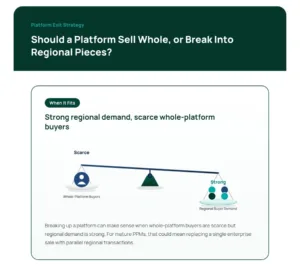
Carving a platform into regional lots can sacrifice the consolidation premium and scale synergies a single enterprise buyer might pay for, while leaving shared corporate and management services organization (MSO) infrastructure behind.
Breaking up a platform can make sense when whole-platform buyers are scarce but regional demand is strong. For mature PPMs, that could mean replacing a single enterprise sale with parallel regional transactions.
Applying the Same Logic to Physician Practice Management
Many PPM platforms were built through regional roll-up strategies. If practices can be assembled into larger organizations, then it makes sense to ask whether portions of those organizations could later be separated and sold to regional strategic buyers. How cleanly this translates, though, depends on the specialty. Site-based, referral-driven, density-sensitive practices—the profile urgent care exemplifies—separate into regional lots most readily. Platforms built around shared ancillaries, ambulatory surgery center economics, or hospital call coverage may be difficult to divide without losing value.
For health systems, these acquisitions may be attractive because much of the operational integration is already done: Instead of acquiring dozens of independent practices individually, they’re evaluating an organization that already operates as a cohesive platform.
In the face of extended hold periods, regional divestitures offer another path to liquidity for sponsors. They create an opportunity to return capital while potentially repositioning the remaining platform around a new strategic focus. At the same time, health systems recognize that physician employment is likely here to stay; however, many are growing frustrated with outdated employment models that can create misalignment and drive high practice subsidies. Alternative professional corporation/management services organization (PC-MSO) structures may offer health systems greater flexibility to attract and retain physicians who are better suited to a different practice model and culture.
Of course, not every PPM platform can or should pursue this strategy. This historical example may serve as a blueprint, but it is not a crystal ball. However, it does represent a viable option as traditional exits are growing more difficult.
 The Opportunity Comes with Complexity
None of this suggests that regional divestitures are easy. Selling a single platform is challenging enough; running multiple regional sale processes at once requires significantly more coordination, buyer outreach, financial reporting, and transaction management. If portions of a platform don’t command enough strategic interest, sponsors may retain them, work to redefine the remaining business, and implement a new growth strategy.
And PPM carve-ups carry structural baggage urgent care largely did not. Disentangling a regional cluster from the platform’s existing PC-MSO structure can create complications around payer contracts, non-competes, and other agreements. In states with corporate-practice-of-medicine restrictions, a nonprofit health system buyer may face additional constraints.
Corporate-practice-of-medicine restrictions can add another layer of complexity for nonprofit health system buyers, resulting in a transaction that can be far more complicated than the site-based, real estate–heavy urgent care sales of the past.
These mechanics, on both the sell side and the buy side, are involved enough to deserve their own treatment.
Extracting greater value often requires more work; however, for sponsors seeking liquidity in a constrained exit market, that additional effort may be worth it.
What Health Systems & Private Equity Sponsors Should Watch
As hold periods stretch, the market may begin revealing whether this approach gains broader traction. Watch for sponsors marketing regional assets, health systems competing for localized acquisitions, and investment banks presenting more sum-of-the-parts strategies as viable exit alternatives.
The urgent care exit playbook may offer a steady drumbeat for PPMs to follow, and reports that Optum is exploring selling portions of its physician portfolio suggest that the broader market may already be testing similar ideas. As healthcare organizations like Optum—along with other payviders, private equity investors, and physician groups—reassess which assets best support their long-term strategies, portfolio optimization has emerged as a defining theme.
For some that creates uncertainty; for others, it creates opportunity.

Healthcare leaders who recognize emerging patterns early are better positioned to act. Connect with VMG Health to turn evolving market dynamics into informed strategic decisions.
THE Physician Practice Management SERIESKeep the Conversation GoingExplore four perspectives on the changing physician practice management landscape, from private equity trends to alternative buyers. |
|||
|
01 Private Equity in Physician Practices: PPM Is Changing Explore how the physician practice management landscape is changing and what comes next. |
02 Is the Urgent Care Exit Playbook the Blueprint? What could urgent care transactions reveal about the future of PPM platforms? |
03 One Less Bidder: What Optum’s Retreat May Mean Examine what Optum’s retreat could mean for private equity–backed physician practices. |
04 Could Strategic Health System Buyers Rewrite the Exit Playbook? Investigate whether and when a strategic health system buyer offers an alternative to a traditional PPM platform. |